Meet Color Congress’ New Staff
By Color Congress
As we complete our third year in operation, we are thrilled to bring on two new team members to expand our capacity and support for our members. Learn more about these two fantastic folks below.
Introducing Michelle Y. Hurtubise, Membership & Events Manager
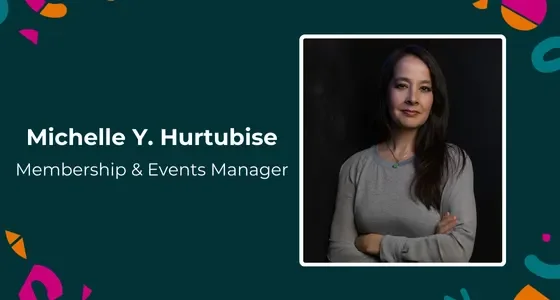
Michelle has advocated for narrative sovereignty for diverse storytellers throughout her PhD journey in Visual Anthropology at Temple University and brings this passion to Color Congress as the Membership & Events Manager. She co-founded and developed Kin Theory, an Indigenous media makers database, and helped coordinate the 4th World Media Lab. With a 2022–2023 Fulbright Fellowship, she collaborated with the imagineNATIVE Film + Media Arts Festival and Vtape in Toronto. Originally from San Francisco, Michelle (Cantonese American, Irish and French descent) did human rights and media work in Rio de Janeiro as part of her MA at New York University, received an MFA from the University of Hawaiʻi at Mānoa, worked with the Center for Artistic Activism, and with the Center for Media, Culture and History. She currently resides on Lenape land in Philadelphia.
In her role, Michelle will coordinate monthly meetups, public conversations, and the biennial National Convening, along with facilitating member connections and peer-learning, and uplifting their thought leadership in the field.
Who are your people? Who do you bring into the room with you?
My mom! I’m lucky with my diverse family, we challenge each other and yet are very committed to loving each other. My father is of midwest Irish and French descent, and alongside my Cantonese, San Francisco Chinatown mother, my sister, brother and I grew up moving around Turtle Island. I now live on Lenape Land with my partner, but we spent the last two years traveling for his research to large-scale ecological restoration projects, and we spent a year in Toronto for my work with the imagineNATIVE Film + Media Arts Festival. Mentors and teachers have also had a huge influence on me. Tracy Rector (who previously was on the board of Color Congress) brought me into the film industry in wonderful ways. Her community of Indigenous filmmakers through the 4th World Media Lab, other fellowship programs, and initiatives have profoundly shaped me. Together we created Kin Theory, an Indigenous media makers database, whose online and in-person community showed me how Indigenous-led futures are brimming with joy, reciprocity, and abundance. These creators still fill my room.
How does the concept of narrative sovereignty guide your work?
I first heard Jesse Wente (the inaugural Executive Director of the Indigenous Screen Office in Canada) talk about narrative sovereignty six years ago, and it has been incredible to see it make its way from a concept into funding and film festival structures. It is so much more than an important idea — where rather than media being about a community, it should be made by and for them. The impacts of narrative sovereignty on screen also have huge implications off-screen for creators and communities of color. From local screenings to national funding opportunities, to Indigenous radical resurgence in all ways of life, narrative sovereignty is powerful. I have been following the threads of narrative sovereignty, from an idea and theory, to practice and policy, throughout my dissertation in Visual Anthropology at Temple University. Filmmakers of color have shown me what narrative sovereignty looks like in practice, and they also bring into conversation the incredible work of DAWG, Color Congress, IllumiNative, and more values-led organizations that are revolutionizing the system.
What is the role of nonfiction in today’s social and political climate?
If facts alone changed people, we would live in a very different world. We need stories to shape hearts and minds, to move communities into action, and to move from surviving to thriving. Nonfiction storytelling can lead people into a new way of being and opens the door to understanding our neighbors. The education and facts that nonfiction films share are also important. At this year’s Seattle International Film Festival screening of Standing Above the Clouds, the all-femme team including Director Jalena Keane-Lee and Producers Erin Lau and Amber Espinosa-Jones eloquently spoke about the rich layers of their film and communities. I was struck when they said that with this film, they don’t just want a win that the press would recognize, they want to give the audience hope, hope in knowing that women are fighting, resisting, cultivating healing strength in each other, and existing beyond what colonialism prescribes. Nonfiction filmmaking can be an act of liberation. Hope is critical, and while it does not operate alone, we need it to persevere through the ongoing traumas and horrific genocides taking place today. Nonfiction storytelling brings communities together, it feeds us and fuels us.
What has building community across differences meant for you in your life and career?
It has meant taking a lot of different pathways, but I’m extremely grateful it led me here. I learned more about my Chinese roots by moving to Hawai’i to study Asian Theatre and joining the Theatre Esprit Asia company in Colorado, but I always seemed to be missing something. When I met Tracy Rector, I was opening myself up to see where my work and experiences might be useful. In diving into Indigenous-made media, it actually brought me deeper into my own family’s history. For example, the imagineNATIVE Film + Media Arts Festival is part of five artist-led organizations that make up The Commons @ 401, including the Toronto Reel Asian International Film Festival. I learned how these diverse organizations came together to survive the COVID-19 lockdowns. Also, the Executive Director of Reel Asian, Deanna Wong’s family was instrumental in getting reparations for Canada’s Chinese Head Tax, which my family received. The more a community can tell their specific stories, the more they can help each other with their unique histories, strengths, and insights. These connections build bridges that deepen cultural anchors, while also creating new pathways between and for diverse communities.
_____
Introducing Alece Oxendine, Marketing & Initiative Director
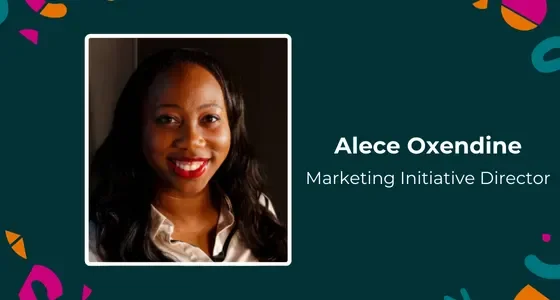
For almost 15 years, Alece has dedicated her career to guiding emerging filmmakers through their work in marketing, distribution, partnerships and strategy at such
organizations as film at Lincoln Center, BAM Cinema, Rooftop, Athena Film Festival, Fandor and Good Deed Entertainment. She joins us from her most recent role as director of Industry and Festival Outreach at Columbia University. She advised on career paths in producing, directing and writing. Alece is an esteemed alum in a of Columbia University where she serves on their alumni board and a proud HBCU graduate of Winston‐Salem State University. In her free time she enjoys writing and telling stories in any format.
Alece will direct our two-year Marketing & Distribution Initiative. More on that in an upcoming blog post!
Tell us who are your people? Who do you bring into the room with you?
I bring a lot of people, a lot of ancestors that I always bring into the room. I am a descendant of the Lumbee tribe in North Carolina. We are the largest tribe east of the Mississippi River. We are not federally recognized as a tribe, only on the state level. I always have to rep for my Lumbees. And the ones I hold near and dear are my sisters, I have three sisters. When I tell you they gather me, they collect me, they support me, and I know I can always count on them for any advice. Those are the people I always carry with me at all times.
When did you first fall in love with film?
Oh, gosh, I first watched 12 Angry Men when I was about 12 or 13 years old. My siblings were like, “You go watch that old movie. We are going outside to play!” I was hooked by the storytelling, and I loved how the action only took place all in one room. Even before that I was a library kid. Every Saturday morning my dad would take us to the library. I would always go straight to the media section. My dad would say, “You got to get a book, Alece.” But I am like “but the movies are right there.” I went to an arts magnet school and it is so important to keep arts in schools, especially for kids of color, because that’s how we express ourselves. I always had the freedom to express myself in creative ways because my parents gave way for that as well. Being at an arts school, I did everything.. I directed a play at 14. I had artwork sold when I was 12, and so I was really just an artsy kid. But then I got that film bug and I stuck with it.
How did distribution become the area you chose to focus on?
I was living in the San Francisco Bay Area and working for Fandor and doing social media. I was a very successful social media manager, but I was plateauing and didn’t know what I was going to do next. I remember what this producer named
Ted Hope once said:, “go where innovation is and you’ll always have a job.” It hit me like a ton of bricks: distribution. Ever since then, I’ve pursued work in distribution. It’s been exciting, a tough time, but I know there’s innovation here, and more importantly, here’s important knowledge here. And I was starting to realize that a lot of filmmakers don’t know much about distribution. I have been on a crusade ever since to educate filmmakers on distribution. I would talk at length even on the Distribution Advocates podcast that the industry benefits from your ignorance; the less filmmakers know about distribution, the better. I said, well, let’s flip the script. And that’s exactly what I did. I flipped the script and it ended up costing me everything. I was at an event in L.A. talking about how I would go to buyer screenings for Black films and I’d often be one of two people of color in a 200 seat theater. A reporter from The Wrap overheard me and asked for a quote. This is at the height of the #MeToo movement and I felt the need to call out the lack of diversity in distribution. Basically, the people who decide what you see on streaming platforms are straight white men with MBAs. I spoke openly about this and to no one’s surprise I was without a job in distribution and essentially blacklisted.. It cost me everything and I’d do it again. People finally started talking about the fact that the experts who are in distribution are mostly white. So I said let me try to get out there and show that hey, we do exist. But standing up for what’s right and trying to find a voice for filmmakers and distribution, that is when it became my life’s work. If it’s going to cost me everything then that means I am saying the right things.
From there I went to work at Columbia University and it became a place for me to heal. When the pandemic started, every month people were asking me to speak on virtual panels about distribution. I wondered, did they not read the article? I know I made a lot of people mad! But I kept going and helping filmmakers unpack distribution. Columbia was a tough place to be, that’s why I appreciate everyone being open and talking about what’s happening. Being at Columbia became very difficult. This was around the time of the protests in support of divestment and the NYPD coming on campus. I knew I couldn’t work for a place that caused communities of color so much pain. But it was time for me to move on, and that experience speaking up for diversity in distribution led me here at Color Congress.
I am so deeply grateful to be in this position where I get to come back to my first love of distribution and really help out people like all of you and all of the people that you all the filmmakers that you work with to make a difference in this industry.
Where do you find joy these days?
A lot of people talk about self care but for people of color our self care is in community. So I find joy in community. I recently went to Central Park and had a picnic with some of my friends. That brings me joy. Community is my love language.
You can hear Alece’s thoughts on Marketing & Digital Distribution Practices here.