Mobilizing Narrative Sovereignty
By Michelle Y. Hurtubise
The highly-awarded Anishinaabe filmmaker Lisa Jackson, known for her genre-defying documentary and fiction films, virtual reality and multimedia installation works, recently sat down with our Color Congress member organization, the 4th World Media Lab, at the Points North Institute this September to talk about her career as an Indigenous creative before her film, Wilfred Buck, screened at the 2024 Camden International Film Festival (CIFF). This was the ninth fellowship cohort of the 4th World Media Lab, which is a unique year-long fellowship for emerging and mid-career Indigenous filmmakers that invests in creatives at a crucial time in their journey. While they gain industry access, develop their pitches, and learn from the seasoned professionals, at the heart of the program is also the relationships they form with each other. Having space to gather as diverse creatives is so important and yet remains rare in the larger industry. These are all crucial elements in supporting narrative sovereignty, where the storyteller and their community are prioritized.
These fellows travel together to the Big Sky Documentary Film Festival, the Seattle International Film Festival, and CIFF, which made this their last stop on the Penobscot territory of the Wabanaki Confederacy. It was a heartfelt, powerful time together. At their first gathering at Big Sky, Quechua Aymara filmmaker and fellow, Sisa Quispe, said her experience there felt grounded by a sense of Ayni — a Quechua concept of reciprocity in her community. At the closing CIFF dinner, Quispe shared again that while her heart was overflowing with gratitude, there was no exact word for thank you in Quechua. Instead she offered Urpillay Sonqollay, and said that her heart was flying like a bird. Everyone expressed their heartfelt agreement.
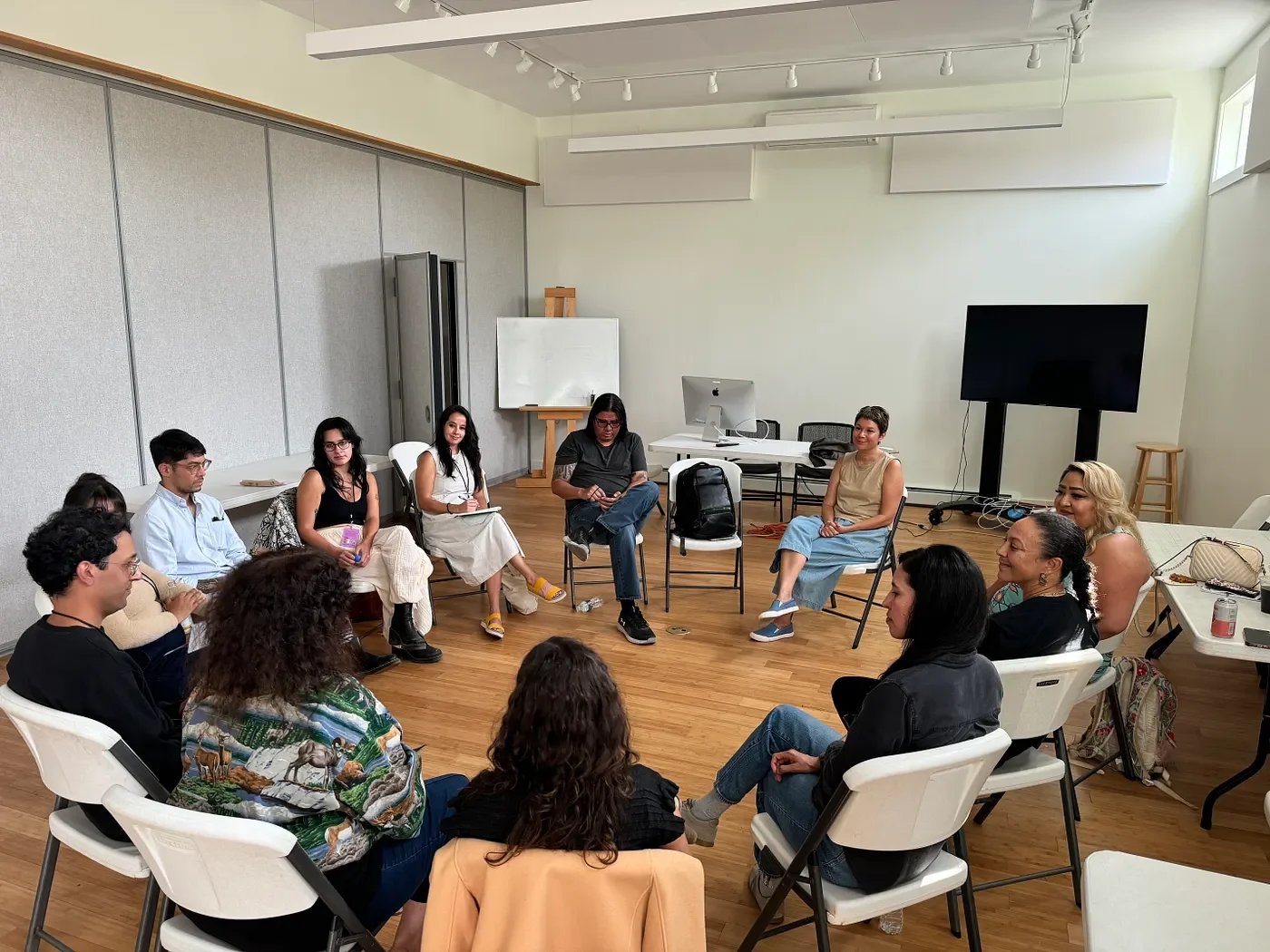
Lisa Jackson speaks with the 4th World fellows and partners at CIFF. Photo courtesy of Tracy Rector and the 4th World Media Lab.
Before becoming Color Congress’s Membership & Events Manager this year, I was the program coordinator for 4th World. As I traveled with the fellowship cohorts, I witnessed how connected and resourced POC filmmakers and leaders ignited transformation. I saw this in the multi-generational impact 4th World fellows had on each other. Over the years they would mentor and uplift each other, bring one another onto projects, and gather at festivals together year after year. At Big Sky 2024 there were over six generations of 4th World fellows participating in almost every aspect of the festival — from the pitch competition to school visits, award-winning screenings, DocShop, and the fellowship program. Long-time supporter of the program, Jannet Nuñez the Senior Manager, Content & Development at ITVS said, “If you need any proof this fellowship is making an impact, this is it.” Relationships can have a durational impact when valued and centered as part of a growing community.
The founder of 4th World, Tracy Rector, a multicultural filmmaker, curator, and organizer, has experience cultivating meaningful relationships, and met Jackson twenty years ago at another prominent film gathering, the now-defunct, All Roads Film Festival by National Geographic. This was another rare and important gathering space for emerging Indigenous filmmakers at the time. Rector and Jackson spoke in Maine to the fellows about the incredible talent that was gathered in the room back then, including Taika Waititi, Sterlin Harjo, and Blackhorse Lowe — who all took part in the Indigenous-led hit FX series Reservation Dogs that recently received four Emmy nominations. In Camden, the talent was also overflowing with the 4th World fellows alongside other Points North artist programs, including the BlackStar Film Festival’s North Star Fellowship for Black, Brown, and Indigenous media innovators conducted in collaboration with the William & Louise Greaves Filmmaker Seminar.
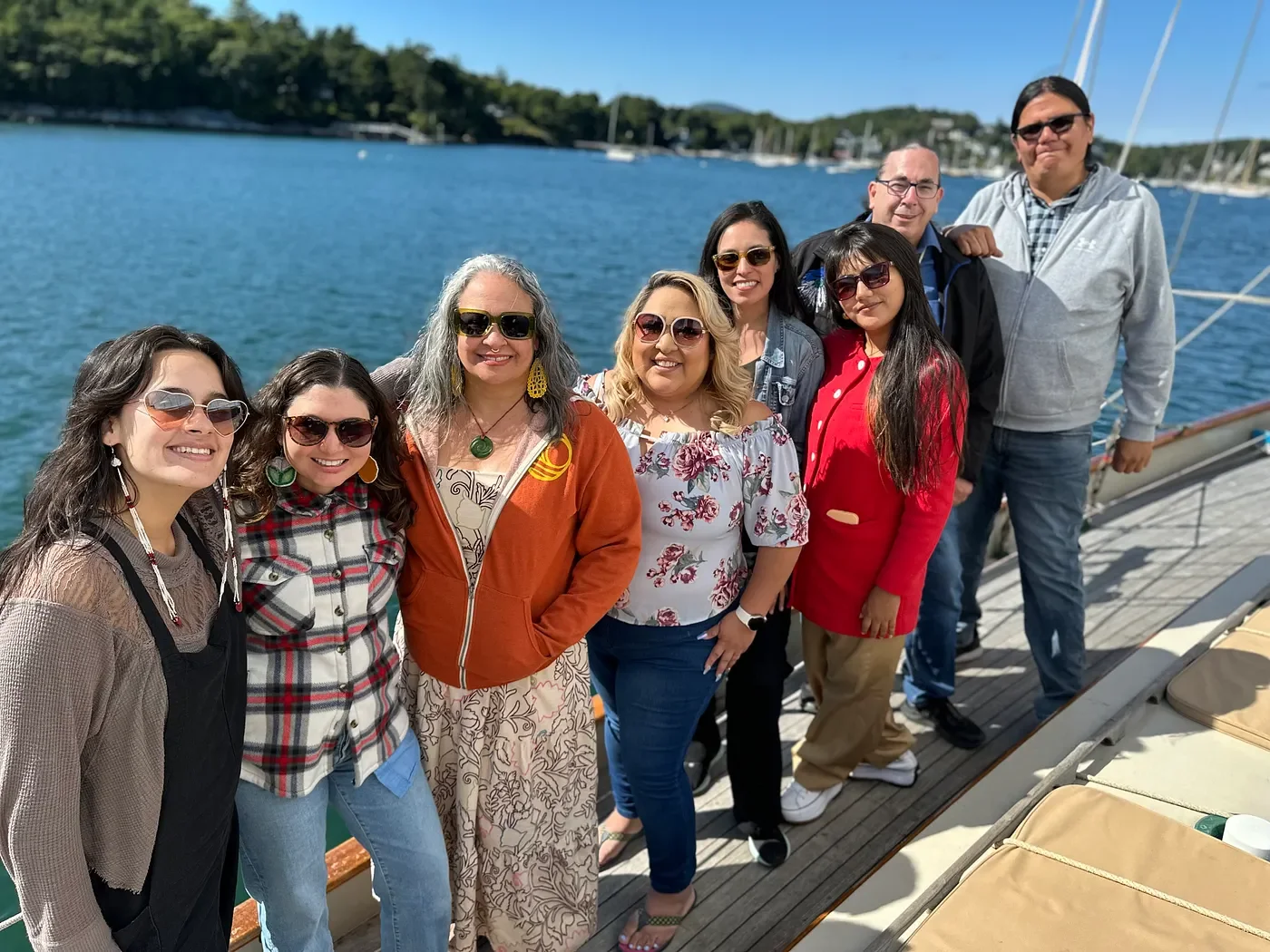
Fourth World fellows and friends take a sail on the deep blue Penobscot Bay in Camden, Maine. Pictured left to right are: Victoria Cheyenne, Cass Gardiner, Tracy Rector, Kansas Begaye, Jannet Nuñes, Sisa Quispe, Chris Newell, and Bruce Thomas Miller. Photo courtesy of Josh Povak and the Points North Institute.
When we focus on POC storytellers and invest in a person — not just a story as a product — this anchors media making in the community, where rather than external, extractive filmmaking, there is a reinvestment in creatives who are embedded in their communities. Indigenous filmmakers speak about reciprocity and their deep responsibility to their communities, and how they bring folks along with them in their storytelling work. Narrative sovereignty in this sense is not just an individual’s self-determination, but is also co-created with community.
Narrative sovereignty is where media is made by, for, and about the community, but it also extends as an important concept of how to support, fund, and program these diverse storytellers. I was introduced to the concept of narrative sovereignty by Ojibwe writer and broadcaster Jesse Wente, the first Indigenous Chair of the Canada Council for the Arts and inaugural executive director of Canada’s Indigenous Screen Office (ISO), who helped shift public discourse away from representation, cultural appropriation, and colonial guilt towards framing the conversation around authorship and Indigenous narrative sovereignty on screen, and how to support it.
Wente said, “It is Indigenous peoples who should be telling our stories, and it should be Indigenous peoples deciding how that is done and by whom. Anything less ensures that media creation remains a colonial practice, one that extracts rather than reciprocates” (in Doing All Things Differently).
Jackson spoke to the 4th World fellows about the crucial importance of Indigenous screen sovereignty and how it is gaining momentum, growing from movements like “nothing about us without us” and drawing on a deep lineage of Indigenous self-determination and sovereignty movements in the arts (which I write more about here). Narrative sovereignty has become a standard for funders and broadcasters in Canada and is being picked up in more conversations in the United States and abroad. Rector also spoke about narrative sovereignty that weekend and the limits of allyship on a panel at CIFF following the deeply moving screening of No Other Land (by the Palestinian-Isareli collective with filmmakers Basel Adra, Hamdan Ballal, Yuval Abraham and Rachel Szor). Drawn from Indigenous leadership, the concept of narrative sovereignty is powerful for filmmakers and communities across the globe who are fighting for their land and driven by care, responsibility to community, and authoring their own stories.
Rector said, “Narrative sovereignty is the right of a group or community to control and shape the stories, narratives, and representations about themselves, their culture, and their histories. It’s about having the ability to define and share one’s own perspectives, experiences and stories — authentically with consent, agency, and care.”
Narrative sovereignty moves beyond (still necessary) reparative work into positions of power through authorship. It values the storyteller as centrally important to what we see on screen, read, and hear. Representation is never enough and often problematic (as The Lens Reflected report illuminates). Telling one’s own story is not only a right, but it can lead to crucial narrative shifts and social change. It should be prioritized by institutions and funded at scale.
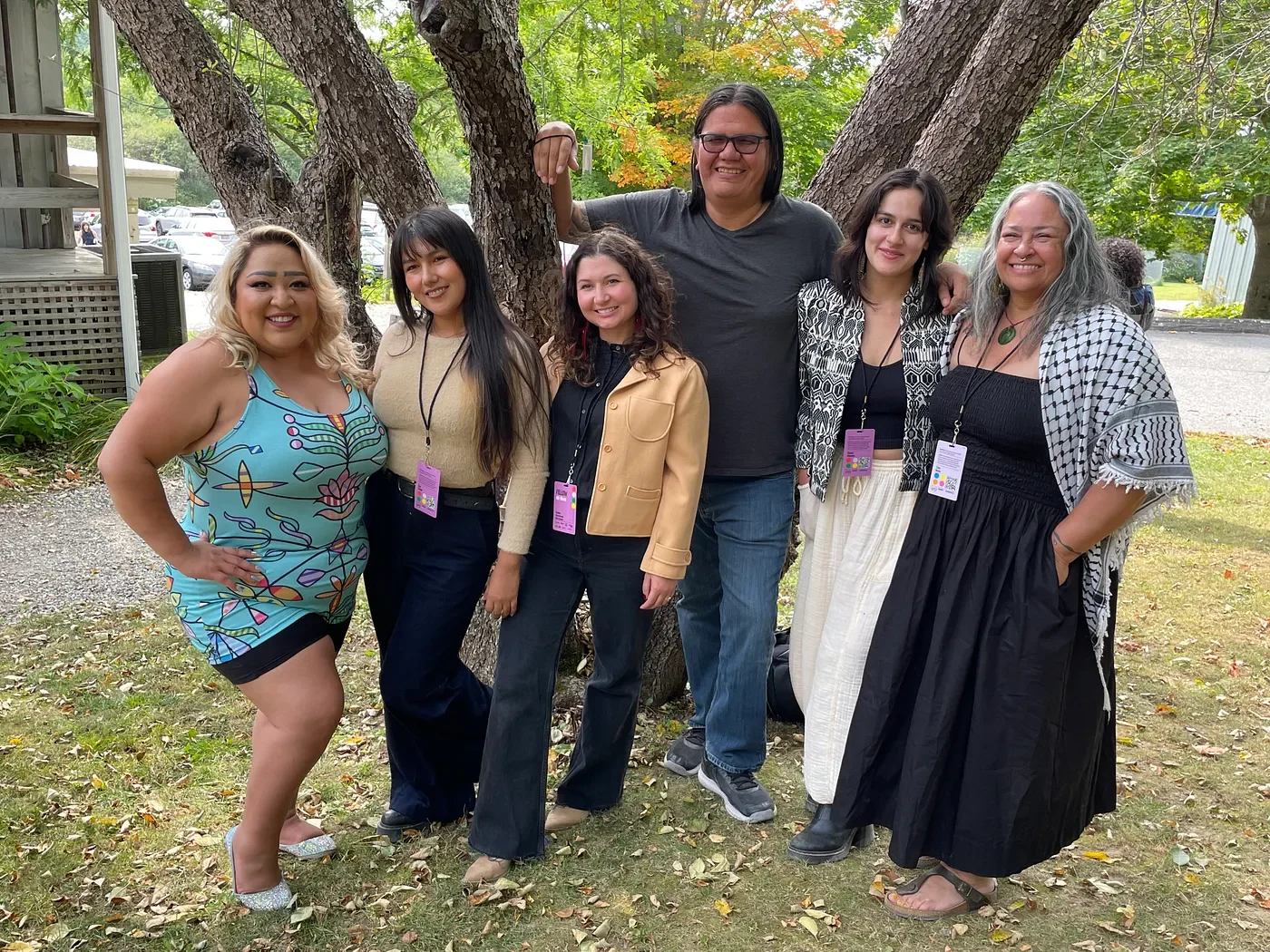
The 2024 4th World Media Lab Fellows at CIFF stand in front of a beautiful tree, from left to right: Kansas Begaye, Sisa Quispe, Cass Gardiner, Bruce Thomas Miller, Victoria Cheyenne, and founder Tracy Rector. Photo by the author.
Individual filmmakers, like the 4th World fellows, are embracing narrative sovereignty in their filmmaking choices, in who they are in relationship with, and in their community-driven values. There are also organizations adapting narrative sovereignty as a core value in their funding and programming requirements. In addition to our work with 4th World, Rector and I co-founded Kin Theory, an Indigenous media makers database, which we developed with a dynamic team and built it upon the principles of narrative sovereignty, where the storyteller is centered.
The Indigenous Screen Office (ISO) is doing this, in their public-facing materials and in who is eligible for their funding programs. The imagineNATIVE Film + Media Arts Festival also implemented narrative sovereignty as an institutional value from the beginning (25 years ago), where two of the three key creatives on a project (writer, director, producer), must be Indigenous to be eligible for their festival. Together the folks at ISO (before it was formalized) and imagineNATIVE created a robust document with community about how to implement narrative sovereignty in productions entitled: “On-Screen Protocols and Pathways: A Media Production Guide to Working with First Nations, Métis and Inuit Communities, Cultures, Concepts and Stories,” (prepared in 2019 for imagineNATIVE and expanded by the ISO). In it, Cree/Metis director Danis Goulet, (who is on the board of directors at TIFF, is in the ISO Membership Circle, and was the Director of imagineNATIVE), heralds that the age of the Indigenous consultant is over and that they must be in leadership positions.
“It is FAR past time for the era of Indigenous consultation in the arts to be over. Indigenous people must have KEY creative positions in work made about us, full stop. Otherwise, the colonial relationships/gaze continues,” said Goulet.
Industry access and power building among these leaders is making Indigenous narrative sovereignty and authorship more often a requirement than just a good idea in the industry. This took years of home-grown efforts. Jackson (who is also in the ISO Membership Circle) and Goulet’s impact on Indigenous media, especially in Canada, would look like a mycelium network if mapped out over the last twenty years. But these pathways had to be created collectively, and Jackson shared some key moments and relationships with the 4th World fellows about the long road to get here.
Indigenous filmmakers often find each other at film festivals, some got to know each other through the Embargo Collective, and many found each other at imagineNATVE. Indigenous directors and producers got to talking in various places, including around kitchen tables — like Goulet’s (and Métis filmmaker Shane Belcourt’s) — about why none of them were getting funded for their feature films. At the time, there was some recognition for award-winning shorts, but there were barriers to bridge the gap in funding to make features. Commissioned by imagineNATIVE, when Anishnaabe programmer and producer Jason Ryle was Executive Director (Ryle led imagineNATIVE from 2010–2020), Indigenous filmmakers contributed to a report on the state of the field and demanded change. This 2013 report, “Indigenous Feature Film Production in Canada: A National and International Perspective,” led by Goulet and Kerry Swanson (who is now Chief Executive Officer of the ISO and was the Board Chair and Executive Director of imagineNATIVE), not only highlighted funding gaps for Indigenous filmmakers but pointed towards an incredible opportunity — people want diverse stories by POC creators funded by POC leaders. This data laid the groundwork for what would become the ISO six years later, and for which these Indigenous filmmakers and leaders advocated for each step of the way.
In the United States, IlliminNATIVE has created valuable reports on Indigenous media and its makers, like the seminal 2018 study, “Reclaiming Native Truth.” The Pawnee founder and executive director Crystal Echo Hawk has had a huge impact on creatives and also writes about and advocates for narrative sovereignty. They recently announced that IllumiNative is growing to support Indigenous productions through IllumiNative Media. Narrative Sovereignty is part of an individual filmmaker’s choices, but it is also a deliberate choice for programmers and funders. Who supports these filmmakers of color sheds light on the industry and who is advocating for change. Sahar Driver’s 2020 report, “Beyond Inclusion: The Critical Role of People of Color in the U.S. Documentary Ecosystem” proved that it is not only still incredibly difficult for filmmakers of color to make their films, but that the longstanding POC-led and serving organizations have been systematically underfunded but continue to have a significant impact on communities, audiences, and filmmakers.
Driver’s “Beyond Inclusion” report led to the formation of the Color Congress, which is now a connected wellspring of POC leaders serving POC filmmakers and includes over 113 Color Congress member organizations. If narrative sovereignty were to be institutionalized as a funding and programming priority in the United States, these organizations are the ones already leading the way.
The ISO has already had a sizable impact on the Indigenous filmmaking landscape, but last year they were excluded from the federal budget. There was an organized public outcry, and the government changed its mind. In March 2024, the Canadian government announced, “permanent funding to support Indigenous-led storytelling through the Indigenous Screen Office (ISO). This includes $65 million over five years starting in 2024–25 and $13 million per year ongoing. The funding will enable more First Nations, Inuit and Métis peoples to tell their own stories and see themselves reflected on screen. It provides stability, increases Indigenous self-determination, and allows the ISO to develop long-term relationships with partners and sponsors.”
If Indigenous filmmakers can gather around a kitchen table, demand change, show the research, and create Canada’s first-ever National Indigenous Screen Office, where will the Color Congress be in six years if we continue to work together for narrative sovereignty?
I have been deeply moved to witness the 4th World fellows and young POC filmmakers leading with joy, care, and abundance — which in many ways is already revolutionary in a capitalist system often focused on scarcity and competition. When we come together power shifts, and the data backs up the impact. As I listened to Jackson and looked around the room of 4th World fellows, I wondered where their talent and relationships would take them. How would this group of Indigenous filmmakers guide audiences, shape genres, and break molds? Jackson encouraged them to write letters demanding accountability and change, to organize, to make their stories their way, and stressed again to “work collectively!”
Michelle Y. Hurtubise is the Membership & Events Manager at Color Congress.
Slight adjustments were made to this piece October 16, 2024 to clarify the creation of the report, “Indigenous Feature Film Production in Canada: A National and International Perspective,” commissioned by the imagineNATIVE Film + Media Arts Festival.