Color Congress Welcomes Jina Chung as new Development Director
by Color Congress Staff
We are thrilled to announce our first Development Director to ensure our sustainability and our ability to support our members. Learn more about our newest team member below.
Introducing Jina Chung, Development Director
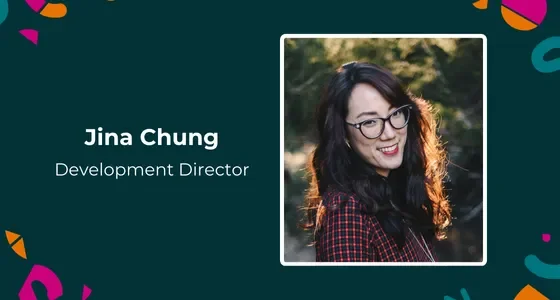
Jina Chung has spent nearly 15 years in fundraising and nonprofit management. She is a fierce advocate of Community-Centric Fundraising and helps mission-driven organizations use fundraising models rooted in equity and social justice to support their vision. Jina was the Senior Director of Development & Partnerships at the International Documentary Association (IDA), overseeing membership, institutional and individual giving, and corporate sponsorship programs. She also managed a diverse portfolio of income-generating programs, including Screening Series, IDA Awards, Awards Spotlight, and advertising. She served most recently as the Executive Director of Frequencies of Change Media, which produces “Making Contact,” an award-winning radio show and podcast. Originally from Long Beach, California, she now resides in Texas.
Who are your people? Who do you bring into the room with you?
My mom holds the VIP badge in the room. I can’t say I always saw her as a badass, but I can 100% confirm she is one through and through. My mom is such a complex person, who can be both highly conservative in the ways her Korean culture and Christian faith shapes her worldview, while also being open in her support of my creativity and its many personal and professional outputs. I am grateful she never forced or asked me to pursue law or medicine, a common expectation for immigrant children growing up in the States. I rely on my colleagues-turned-friends, Amy Halpin, Maggie Bowman, Cassidy Dimon, and Poh Si Teng for accountability and gut checks. They taught me how to courageously stand up for my values in the face of significant personal and professional risk. A room isn’t a room without my four boys: Isaac (partner), Atticus, Arlo, and Rocket (furbaby). They make life chaotic, complete, and joyful!
When did you first fall in love with film?
My “fall in love” moment happened when I saw The Matrix in middle school for the first time. It was the first film that I had the maturity to understand and experience how a movie becomes a pop culture phenomenon. I was endlessly fascinated by how a film can generate many theories and conversations across age and gender. Fast forward to my college years, and my film love affair went to the next level when I discovered independent cinema. My film studies classes exposed me to documentaries, international films, and a whole new world of storytelling outside of the Hollywood formula. I instinctively associate some of my favorite films to distinct periods of my life to my favorite films. The Matrix encapsulates my middle and high school years. Edward Yang’s Yi Yi and Ingmar Bergman’s Fanny & Alexander immediately bring me back to my university days in upstate New York. My current decade of life is my documentary era!
How did development become the area you chose to focus on?
A common trait I’ve discovered with other development folks I met is that we all majored in art history. I don’t know what about this particular academic discipline that pumps out 80% of the fundraising professionals, but someone should do the research! All jokes aside, I think what draws me to development is the entrepreneurial nature of the work that requires tenacity, experimentation and strategic thinking. Development is an ever-evolving field that responds quickly to philanthropic and economic shifts. I thrive on problem solving and enjoy collaborating with my colleagues to brainstorm programmatic solutions to pitch to funders and donors. On the flip side, I’ve seen the inequitable gaps in fundraising as a development consultant working with small nonprofit organizations with super tight budgets. The adage that you have to “spend money to make money” is ingrained in fundraising, but that is often out of reach for many nonprofits. I feel compelled to stay in development because we can’t truly disrupt the nonprofit industrial complex without changing how money flows in and out of our sector.
How does the concept of values-based fundraising guide your work?
It’s been 5 years since I first learned about values-based fundraising, and I can wholeheartedly say that it’s changed my life. The traditional fundraising model seems so simple. Talk to the donor, receive a donation, thank them profusely, rinse and repeat. Values-based fundraising upends that whole narrative and makes our work political. When I wrote my essay four years ago, we were in a moment where it felt like our entire country was looking inward and trying to reckon with our racist history. At that time, I felt like people were more open to values-based fundraising and many organizations shifted their fundraising to be more equitable. I would be disingenuous if I didn’t admit that I often felt demoralized by the snail pace at which we are moving towards values-based fundraising as a sector, or even the number of times I had to resort to donor-centric fundraising to make revenue goals. I have a more nuanced practice that guides my work today. Values-based fundraising isn’t a performative checklist but an accountability framework. Should we pursue this grant opportunity or pass it along? Do we need to do this end-of-year campaign when we have a surplus? I have a lot of thoughts, so perhaps it’s time for a follow-up article!
Where do you find joy these days?
I find so much joy in my journaling practice. It’s my special time to unplug from the digital world entirely. Tactile experiences like journaling produce a calmness and contentment that lasts much longer than doomscrolling on my phone, delivering a cheap dopamine hit. Putting pen to paper is also a way to record my day, emotions, and thoughts creatively. Sometimes it’s not about writing anything down, but doodling, stickering or slapping down some colorful washi tape in my notebook. I hit peak joy when I’m cuddling with my two boys under a fuzzy blanket. I love feeling their heads resting on my chest and their warm bodies curled on either side of me like a triptych.
Sahar Driver and Sonya Childress co-direct the Color Congress, an ecosystem-builder that resources, supports, connects, and champions organizations led by people of color that serve nonfiction filmmakers, leaders, and audiences of color across the United States and US islands.