The Art of Artist Support: A Transformative Journey
By Ximena Amescua Cuenca, Firelight Media
“Transform yourself to transform the world” — Grace Lee Boggs
At Firelight Media, where I am the Senior Manager of Grantmaking, we often open our gatherings for filmmakers by referencing works of artists on whose shoulders we stand. We do this to set the tone for the space, ground ourselves, and inspire reflection and intentionality. That’s how I first came across the work of Grace Lee Boggs in 2018, as I began working with documentary filmmakers of color through the Documentary Lab fellowship program. I wanted to understand why so many looked up to her for inspiration at that time. I want to say I immediately understood then the relevance of her insights into healing — but I didn’t — at least not in the way it resonates with me today after being part of the Firelight Media’s artist programs team for about six and a half years. I have been lucky to have been welcomed and mentored into this work by my colleagues Loira Limbal and Chloë Walters Wallace, who were the first to generously show me what it looked like to “walk the talk” of doing the “art of artist support.” As I’ve grown to love facilitating groups of brilliant filmmakers alongside brilliant colleagues at Firelight, I’ve grown to appreciate this work as a revolutionary practice with community building, liberation, and collective care at its core.
Grace Lee Boggs captured this so clearly in her 2015 interview with Amy Goodman for Democracy Now! where she thanked esteemed colleague and leader in the documentary field for making American Revolutionary: The Evolution of Grace Lee Boggs. “I’m so grateful that Grace [Lee] has made this film because I think she has helped make my life mean something to people at a time when I think people need what my life means.” She added, “[The American people] need to know that the revolution is not just angry, it is not just protests. It’s not just a search for power. It’s a search for real problems for how to be a human being.”
I have been lucky to experience being a part of an artistic community since I was five years old, when I played the violin in the Tijuana Youth Symphony Orchestra, and have been particularly influenced and inspired by my grandmother’s career dedicated to working in a wide range of Mexican cultural institutions, and my aunt’s legacy work in public art. Over the last fifteen years, I have turned my hobbies in the arts into a career in documentary film and media. Working with artistic communities in the US and abroad, I have witnessed underrepresented storytellers creating art in their quest to understand themselves and their role as artists as a revolutionary act of expression. Many of us doing this work see artist support as a labor of stewardship as well as love; if we’re lucky, we get to transform ourselves by supporting the artistic journey of someone else; helping to develop their authentic voices and artistic visions by creating a sense of belonging and community with others.
That was the focus of the conversation this last month at the Color Congress members meeting. “Fellowships: The Art of Artist Support,” was a grounding discussion featuring Francis Cullado (Executive Director, Visual Communications), Wazi Maret (Development Director, Comfrey Films), and Taylor Hensel (Program Coordinator, 4th World Media). Together as members, we got to listen to their perspectives on the meaning of doing this work at this time. Wazi, Taylor, and Francis, each spoke about what lies at the heart of this work for them. Their reflections centered on love — for the artist, for community, and for transforming oneself and their organizations. They talked about their work in artist support through concepts of care, courage, healing, justice, and belonging; proudly affirming their personal values while representing the legacy of their organizations.
From the Cherokee Nation, Taylor spoke about the purpose and intention behind the creation of the 4th World Media Lab fellowship, which originates from the Indigenous wisdom passed down by elders that “…when the environment and Earth are suffering…Indigenous storytelling is the medicine to create healing.” Taylor is an artist turned artist-support person who first had the opportunity to be a fellow in the program before joining it as staff, and she describes this work as “life-saving work.” Artist communities are fragile and under threat, and represent hope to people living under repressive regimes without freedom of expression. It is no coincidence that most of us doing this work are aligned in motivation to create and nurture such spaces through artist support programs, giving people space to show up authentically as themselves and feel recognized amongst their peers.
Building trust, having open communication between the staff and the fellows, and prioritizing care and community can be challenging, especially working under the values of a capitalist industry and culture. This tension was brought up during the Color Congress conversation; the principles of care, accountability, trust, and community-building upon which these artist support programs are founded, are constantly in conflict with our sector’s definitions of success and the value assigned to being “a filmmaker” or “artist.” There tends to be a tension when work rooted in anti-capitalist values must exist within a capitalist-dominant culture. While there are many examples of treating art and artists as commodities — such as when an artist’s livelihood relies on a volatile commercial system — the deeper issue, to me, is the lack of recognition of art’s value — and that of the artist — in building a healthier, more collective society. This perspective inevitably clashes with profit-driven models for artistic development. Artist programs staff notice this friction, and design these programs with care for the staff while setting healthy boundaries between the artist and themselves and the organization with their funders. As Francis put it, “…What does it mean to collectively care for the fellows and artists and for the whole organization as well?” Many of us who have done this type of work long enough understand that it’s a constant practice of accountability and self-awareness that requires at least having dedicated resources and a safe work culture to make this possible. Put succinctly by Francis: “It’s an ongoing process and practice.”
Like with any relational type of work, reciprocity is essential. When done intentionally, artist support, especially shepherding artists through a fellowship, tends to attract those of us who are caretakers, who love building community, and who are yearning for individual healing through the collective. To me, that is what makes the work of fellowships and artist support so rewarding and so complex. We are investing in something beyond helping filmmakers create new films or gain temporal industry recognition. By connecting storytellers through building trust and nurturing belonging, we strengthen our community around shared goals and values. Through these intentional relationships, we can act in solidarity and begin weaving networks with others in social movements that share — or can align with — our purpose. Fellowship programs and artist collectives are spaces where we practice this coalition-building, recognizing that it requires a more thoughtful pace — a gentler, kinder approach — to truly move forward collectively and in solidarity.
As the work becomes increasingly challenging, we need to be better allies to each other, both as individuals and organizations. It is much more than finding the right funding streams and funding models, it is also about protecting our civil rights, advocating for freedom of expression, and not accepting backsliding to repression and violence. Spaces like Color Congress, where there is a collective sense of safety, allow us artist-serving organizations to share our experiences, express our needs and exchange knowledge and resources. As more people whose freedom of expression might have been previously taken for granted are also becoming silenced, the need for a more intersectional documentary sector, feels more urgent. When all aspects of artistic expression are under attack, when civic freedom and human rights are being repressed, building a coalition across sectors and organizations, beyond just “social justice” groups, seems urgent and also too far from today. As someone who was born at the U.S./Mexico border in Tijuana, and has deep roots outside this country, I understand the importance of connecting this work within the global context and in solidarity with the international community that is also being impacted by the erosion of human rights. I also recognize that these ideas are not new. They’re as old as the Black and Indigenous people’s liberation movements, with networks and systems already globally working towards collective liberation in this intersectional, cross-national way.
As a part of an artistic community, we must recognize and build on the achievements of those that came before us, and continue to lead the fight for freedom of expression. Our responsibility is to inform ourselves and be the best advocates for the changes we want to make to our field. It is our responsibility to fight back against those who wish to transform by force, or those who wish to repress our expression. Many of the Color Congress member organizations approach their work with this view; it’s also in many of our cultures as people of color to work collectively and in solidarity. Wazi and their colleagues at Comfrey Films advise us to “stay open, curious, and flexible” as a survival tactic and to be able to care for each other and our communities. The member conversation closed with an emphasis on solidarity and our shared values, with a reminder of our love for storytelling as an act of defiance. The sentiment was palpable that when we embody our values, even if it costs us something, we can act in solidarity and community with others and transform ourselves to change the world.
Some comforting words of advice I took from Comfrey Films, were that in addition to scenario-planning to prepare for what may come, the priority must be on “staying focused on community. Because we know so much of what they are trying to do, they want us to be disoriented and overwhelmed and to give up. Keep finding joy where you can, connection, and just stay focused on community, whatever communities you’re working with.”
To the hopeful revolutionaries who dedicate their lives to transforming themselves through artistic expression and storytelling — finding strength in building community and collective liberation — I see you. To my fellow members of Color Congress and all those building spaces of care, intersectional solidarity, and love, I stand with you. Your work is deeply valued, and I draw strength and inspiration from our collective efforts.
Ximena Amescua Cuenca is the Senior Manager of Grantmaking at Firelight Media. Ximena was born and raised in Tijuana, Mexico, and holds a B.A. in Anthropology and Media Studies from Pitzer College, as well as a MA in Cinema Studies with a graduate certificate in Culture and Media from New York University. Ximena lives in Brooklyn, NY with her partner and her dog Kali.
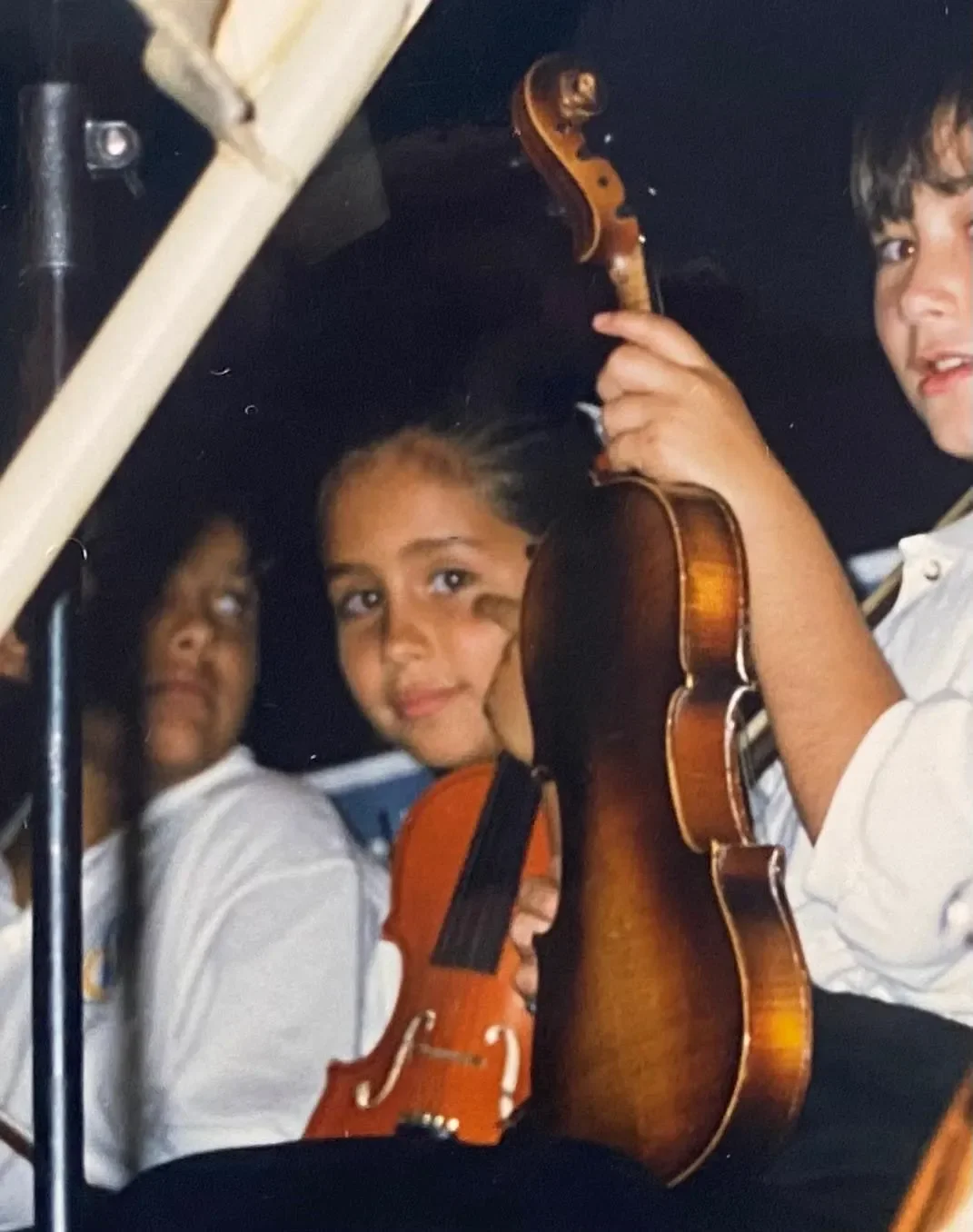
A young Ximena playing violin at a concert in Ensenada with the Baja California Youth Symphony.