
Afrofuturism: defining our own cinematic language
by Ruun Nuur & Ingrid Raphaël
[ af-roh-fyoo-chuh-riz-uhm ]
noun
speculative fiction that treats African American themes and addresses African American concerns in the context of twentieth century technoculture — and, more generally, African American signification that appropriates images of technology and a prosthetically enhanced future.

Although the definition of Afrofuturism was conceptualized in 1993 by cultural critic Mark Dery, in an essay titled “Black to the Future”, his definition merely provided a name for the work and scholarship that Black artists have been conceptualizing since time immemorial. Afrofuturism was born and bred within the cosmology and ideology of ancient Africa and transmitted within the Afro-diasporic experience through memory and oral storytelling.
29 years since its origin, the term has metamorphosed as it has flowed through geographies, mediums, technologies, thinkers, scholars, and makers but the ethos has essentially resided on the same blueprint. AfroFuturism is a multi-functional cultural blueprint made for and by Black peoples.
In many ways, Afrofuturism defies strict categorization. Its spirit requires a nonconformist, chimerical belief system that doesn’t have to be pigeonholed by particular genre aesthetics or technical means. Afrofuturism can and is a valid political and creative methodology meant to push the fabric of culture and society and ancestral memory. It’s by that definition we classify NO EVIL EYE CINEMA as Afrofuturist.
Created by two African diasporic cinematic practitioners and geared toward accessible educational programming and original film curation, NO EVIL EYE CINEMA (NEEC), believes in the possibilities of film despite the historical origin of its entry into the Global South as a means of ethnographic propaganda. That core belief is fueled by uplifting the overlooked histories of Black rebellious ancestral filmmakers: their revolutionary theories, democratized systems of communal making, considering documentary as a means of accessible pedagogy, alternative ways of exhibiting, non-institutional methods of archiving, and more. When in the hands of wayward cinematic dreamers, touching film can be an act of emancipation.
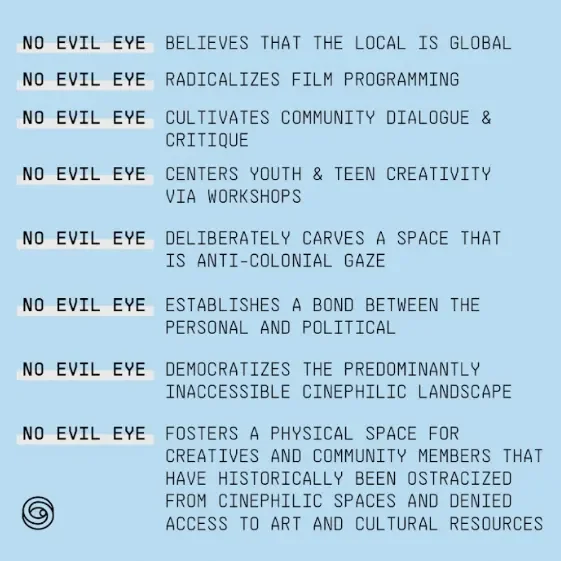
When we first conceptualized NEEC on a late night call in January 2019, we understood that the ecosystem we were invested in cultivating was to embrace all those who have been historically marginalized for the moving image production system via a nomadic approach. Despite our refusal to embrace a clear-cut definition that would be easily digestible to the masses, we took solace in the fluidity of experimenting with classification of our hybrid cinematic space. Thankfully, that inconsequential decision to declare NEEC as nomadic allowed for the microcinema to evolve from irregular in-person screenings and workshops around America to the digital realm once COVID-19 stay-at-home mandates were put in motion.
It’s through that, FILM FUTURA, our most ambitious initiative was born.
We first conceptualized FILM FUTURA (FF) during the heat of summer 2020. It was a moment of unrest across the United States and around the world as millions came together (after months cooped up in the pandemic) to demand accountability for state-sanctioned injustice. It was also a special moment of activation for us as we were reunited in NO EVIL EYE CINEMA’s homebase of Columbus, Ohio to capture the protests across the city for our documentary short film, They Won’t Call It Murder (2022). Despite our immediate task of strategizing around the safety of shooting a film as young Black documentarians within police-infested protests under city-wide curfews and in the middle of pandemic, we were still brimming with ideas on how to best shape our microcinema.
Inspired by the intense moment of political activation, we began brainstorming new ways of growing our then one-year old organization to explore methods of cinematic education. The dream of cultivating an alternative satellite film school that takes a decolonizing approach to profiling the PAST, PRESENT, and FUTURE of film history, practice, and radical cinematic possibilities began to take shape as we grew our team to actualize this major endeavor.
We were honored to host a group of forward thinking film practitioners to challenge the traditional dissemination of scholarship and discourse within FILM FUTURA’s multidisciplinary structure. And most importantly, trust the experimental process of our school alongside the students who helped shape it. While we have meticulously designed the syllabus to reflect a singular perspective of film education with the participation of our amazing invited educators and panelists, our international student cohort is what made FF 2021 what it was and laid the foundation for the future of our educational programming. We’re proud to have created a space for nearly 212 students from novice teenagers to middle age professors, all faith based traditions, races, genders, sexualities, and the like! Our students assist in making this a respectful and engaging mutual knowledge exchange and for that, we will forever be indebted to them.
While FILM FUTURA was originally conceived as a standalone pedagogical experiment, we’ve now re-configured the school to allow for 5-week SHORT TERM COURSES! An extended and deeper analysis of decolonial cinematic education that we’re now implementing in our spring-summer 2023 educational programming with intensives taught by all Black educators. This year’s school includes lecture series outlining varied histories of the cinematic image by critic and scholar Yasmina Price, to a project-based tutorial led by Rory Padgett, a hybrid film critique workshop-seminar guided by Chrystel Oloukoï, and of course, a AfroFuturist worldbuilding intensive hosted by NEEC co-founder Ingrid Raphaël!
FILM FUTURA 2023 announcement
Following an Afrofuturism creative methodology allowed us to dream bigger and freed us from the binaries of traditional film organizational structures. Our afrofuturist film space lends towards occupying the hybridity between the IRL and URL, bridging the gap between the local and global, re-considering the binaries of time, and so much more. Refusing to succumb to unimaginative industry standards has operated as balm for our baby microcinema as we continue to define and redefine the endless boundaries of cinematic possibilities.
No Evil Eye Cinema Co-Founders Ruun Nuur & Ingrid Raphaël
RUUN NUUR is an independent cinematic practitioner hyper focused on Muslim and African narratives and invested in the democratization of cinema’s cultural and technological resources.
Producer of the Field of Vision commissioned documentary short, They Won’t Call It Murder, the film was selected as a Vimeo Staff Pick in September 2022. Nuur is the co-founder of the nomadic microcinema, NO EVIL EYE CINEMA, co-designer of FILM FUTURA, and creator of SVLLY(wood), an independent feminist print film magazine.
Nuur has been named the 2022–23 Artist Residency Award at Wexner Center for the Arts and currently the 2022 Tejumola Olaniyan Creative Writers-in-Residence Fellowship, working on a documentary feature on her homeland of Somalia.
INGRID RAPHAËL is an educator, multi-disciplinary artist, and filmmaker. They are developing a speculative narrative that explores time portals and environmental repair here in Philly and they co-directed They Won’t Call It Murder: available to stream as part of Vimeo’s Shorts Staff Picks. They also co-founded NO EVIL EYE CINEMA and the alternative film school FILM FUTURA.
FIND US ON SOCIAL MEDIA
INSTAGRAM: @noevileyecinema
TWITTER: @noevileyecinema
FACEBOOK: @NOEVILEYE
INSTAGRAM: @phantompdf, @movingbodyofwork
TWITTER: @phantompdf, @movingbodyofwrk