
Andres Jay Molina In Memoriam
A conversation with Vincent Pierce, Peter Yearwood, and Alex Eshelman.
Reality Poet Andres “Jay” Molina, a beloved member of the Color Congress community, recently passed away on July 9, 2025. He was an artist, a filmmaker, a leader, a food lover, and to many: a friend. On July 22nd we sat down to interview some of his Open Doors family, who generously agreed to remember Jay with us. The interview below was held with Vincent Pierce, Peter Yearwood, and Alex Eshelman, who all helped create the award-winning documentary, Fire Through Dry Grass (2023). It has been edited for length and condensed for readability.
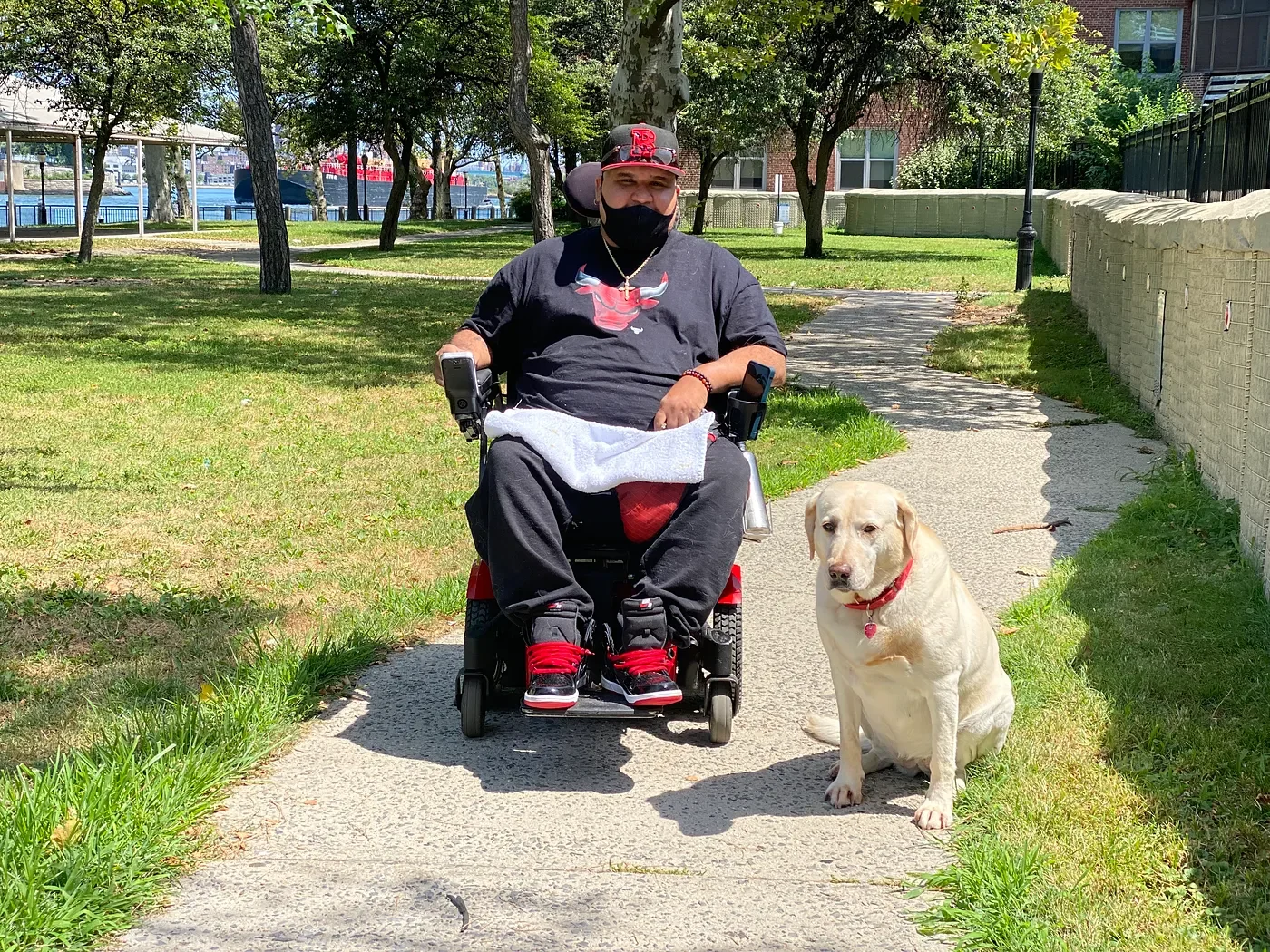
Reality Poet Andres Jay Molina, in a black and red Chicago Bulls t-shirt, baseball cap, matching sneakers and face mask, sits in his motorized chair outside with the sweet yellow Labrador Momo.
Color Congress (CC): We’ve learned a lot about the community you all built through the Reality Poets and Open Doors at Coler (Rehabilitation and Nursing Care Center). Jay gave so much to that. Can you talk a bit about Jay’s role in your community and how he helped bring you all together?
Vincent Pierce: Jay, he was the main piece to Open Doors. We started around the same time and from the beginning, you know, we’d been working, building community by doing things, like going to school, talking to youth, or doing poetry events in the community of Roosevelt Island, especially. We did a play on Roosevelt Island. That was definitely one of Jay’s dreams, to bring it back. And… yeah, I set out to complete that mission for him. [More about this at the end of the post.]
Peter Yearwood: Yeah, it’s just like Vince said. Jay was really passionate about the work that we’re doing. He was really a no-nonsense type of guy. He was, like, straight up, you know? He had a hairy tongue and he would tell you what’s on his mind; he would tell you right off. I appreciated it. But, yeah, Jay was so passionate about Open Doors, you know, and it was just so sad to see his health certainly declining, and… kind of lost a little bit of that passion in the end, you know? He was still there with us. There for us, you know?
Alex Eshelman: Jay was definitely a leader. Like Pete said, he was very pointed. He would tell it as he saw it. Every time. And when you carry yourself that way, it’s very definitive. And it defines Open Doors, you know? He kind of had a lot to do with our identity. Even down to the little things, right? Recently we did a trip to Cirque du Soleil. We were on a call –it might have been a Freestyle Friday–Jay’s like: I want to go to the circus. So he calls Melanie, a supporter of ours, during the call. And before the end of the call, we have tickets! There’s a lot to be said for that, you know, someone who leads with action and just goes straight to it.
CC: Many are familiar with Jay because of his role behind the camera and in front of it in Fire Through Dry Grass. What would you like to share with us about Jay’s role in the film and his relationship to documentary filmmaking?
Vince: We became locked down during COVID. [We had] nowhere to go. We were locked in our units. He had already had a plan of making an Open Doors documentary. I think that idea definitely went into: let’s make a documentary around what’s going on right now. So he hooked up with his co-director, who was teaching him how to work on Premiere and just, how to make a good film (because he was already doing little films, like a sugarcane story and a food story) and it came together. He basically directed us around what he needed from us. We’d strap [cameras] on our wheelchairs and record around the facility. He had the idea, you know; we just followed him, and it came together. Something great. A process we’ll never forget.
Peter: Fire Through Dry Grass had everything to do with Jay. When we were on lockdown, Jay and I were on the same floor. So we used to have our meals together, we used to watch TV. We were in quarantine, you know, so we couldn’t go anywhere. So we’d hang out a lot. He told me one day, because we were seeing what was happening with the PPEs [Personal Protective Equipment], so he said: “Pete, we gotta document this shit, man.” Those are his words. And that’s when, you know, we got GoPros on our wheelchairs and a lot of the footage that you saw in there from meetings that we were having. So… yeah, I would say Jay had everything to do with Fire through Dry Grass. He thought it was something very important, something that had to be done, you know?
Alex: Jay talked a lot about what was his legacy; that was something that mattered to him. It had a lot to do with his drive and why he does the things he does, you know: his writing, his filmmaking, his drive to learn motion graphics and to teach himself, right? He wanted to push the limit of what he was capable of artistically and creatively.
So our next project that we’re working toward is bringing back Fade; it’s the name of a theatrical production we did in 2019. Jay wanted to bring it back as a film. Then we kind of decided it would make more sense to bring it back as a play first. But something Jay’s adamant about: he wanted to make a documentary about the process of bringing it back as a play. I’m telling you this because clearly documentary filmmaking did stick to him. Jay made me feel included in the filmmaking process–this was when I first graduated from school, began working at Open Doors full-time–Jay and Alexi both, they invited me to come spend the day with them as they were working on it, just to, like, let me, you know, see what was actually going into the film. That was pretty cool. I just feel like Jay made me feel included. And not even just with those sort of trivial things, but, they would make me feel included in the sense of if we had something that we had to talk out, or a disagreement, or anything along those lines, I definitely felt seen and respected.
Peter: You’re right about Jay on inclusion. Jay was very big on inclusion. You know, when it came to making this film, he made sure that everybody was included in this film. He made sure that everybody’s voice was heard, you know?
CC: What was Jay passionate about? What brought him joy?
Peter: I would say Jay’s art. He was really passionate about that, because he would spend hours and hours. When he first started out as a filmmaker, he practically taught himself how to use a lot of the programs like Premiere and some other programs. And he would be in the library, he had a little office down there. And he would be there from morning till night, you know, just learning this stuff, learning how to make films. And his writing; he’d be passionate about that, too. As you can tell from some of his poems. And Open Doors also, because he was learning all this stuff to make Open Doors a better place, a more productive place, you know? So art and Open Doors went hand in hand.
Vince: Yeah, I would definitely echo everything Pete said. Where Pete’s missing one is Jay’s love of food. [All laugh.] He was very passionate about his food. And that’s why we’re having his memorial as a cookout. Because it was his favorite Open Doors event in the summer.
Alex: He was passionate about stories and storytelling generally. Like, he loved movies. He loved video games. He liked single-player video games. He liked video games because of the story in them. He was not, like, a multiplayer gamer. He liked the immersive world-building component of it. And specifically, he loves superheroes. Like, Jay was very inspired by superheroes. He looked at the Reality Poets and Open Doors like superheroes. You see this coming up in his writing a lot.
Also, as you see in the movie, Jay loves sneakers. Jay was a sneakerhead. He liked Dunks; he liked Jordans but he really liked Dunks, like Nike SBs.
CC: Do you have any favorite memories of Jay?
Vince: One of my favorites, which, you know, made me happy, was when we was at BlackStar. He came back with that award: the Best Documentary. I felt good to see how happy he was. He told Alexis: “It’s the best day of my life.” You know? And just to see… I’m happy not only for him, but for us too, for the whole documentary team. For us to just win that award, you know?
Peter: I think I have a couple of memories of Jay and it goes back to food again. When he first introduced me to this Dominican dish, it’s like some kind of sweet beans or something that his mother used to make. He introduced me to that, to a version of it, actually. After that, we were like big fans of that dish, you know?
Alex: Jay is the first person I ever gave a guitar lesson to. And that’s a really good memory because he was actually trying to learn. And he was like, when’s the next one gonna be? Oh, he didn’t practice a lot, I know that. [Laugh.] But he did remember what we went over. I taught him the names of the strings and he remembered them. He did. A lot of people can’t remember them. He remembered them.
CC: At this point, that photo of Jay holding out whatever he’s holding his hand in front of that mural is now pretty iconic and it will live on. Can you describe what was happening in that, in that moment?
Alex: It was at DCTV downtown on Lafayette Street. It was after a screening, they pretty much had, like, a Q&A after each one. And this one in particular, it was near the end of the week, after one of the less populated ones, and there weren’t so many of us there that night. I know Alexi was there. We had just gotten dinner after it at some restaurant, you know. Jay ordered some, like, fancy-looking cocktail thing or whatever, and it was just a picture, you know, like, it was nothing more than us having dinner together.
Vince: Yeah, and what he was holding was a cherry.
CC: What lessons did you learn from him that you carry with you?
Vince: “Just do great,” you know? That’s what I would say.
Pete: I think I would take Jay’s attitude, his up-frontness, that way he has to speaking that can tell you what’s on his mind that he’s not afraid to tell you. I think I would take that into my work as an advocate. To always tell you the truth, tell it the way he said [it]. You know, some people might like it, some people might not, because not everybody’s gonna like what you have to say. But you say things the way you see it, you know? And I think that has helped me, and would have helped me in the future. Of being a better advocate, just speaking your truth.
Alex: Very similar to what Pete just said, but, you know, just to be yourself. I don’t think he ever said it that way or that directly. But you know, Jay was himself. And you see someone like that, and you’re like, what are we beating around the bush about, so like, really be yourself, you know?
CC: There are a lot of people whose hearts are heavy these days. And going through a hard time because of this loss, because we’re going to miss Jay. How did Jay stay strong through hard times? What gave him hope?
Peter: You know, to his final days it was still his art. He was still in the library, doing stuff in there. And, I’m taking credit for this, but we also was a part of the strength for him. There was the Reality Poets, you know? He would always call on one of us, either Vincent or myself, if he had something he wanted to talk about, if something was on his mind. He would hit me or Vincent up, you know, and we would talk. I think his fellow Open Doors members and his art.
Vince: Yeah, and I was gonna say a similar thing. Because I heard it come from his mouth before. You are living in a nursing home, you know? [Reality Poets] was something to wake up to. You might be in a nursing home but get up and work, you know? It’s something to wake up to, and to just block out what’s going on around you.
Alex: He had a dog. It wasn’t, like, literally his dog. But this dog, Momo, um, who passed pretty shortly before he passed-probably weeks, honestly, maybe 6 weeks beforehand, something like that. And I don’t know if it’s worth mentioning, but his relationship with Momo, like–Vince, the same way you said it was something you heard from his mouth–it is something I heard from his mouth. He literally is on record saying Momo was one of his reasons, you know? He’s an animal lover, but I guess, like, specifically that dog, you know? I just wanted to mention that, because when I think of Jay, I definitely think of Momo. You can’t have a picture of Jay without Momo. You really can’t.
Vince: Yeah, definitely.
Peter: Definitely, Alex, that’s right.
CC: How do you think he wanted to be remembered?
Vince: Definitely through his art. His words and poetry. Documentary stepped into his art.
Peter: I will always remember Jay as a very fair person, a person who was big on inclusion. He didn’t discriminate against anyone, you know, everybody’s voice was important to him. He just looked out for everybody. He was not a selfish person. If there were things out there, then all of us should be included. And he made sure that that happened, you know?
CC: Are there any last things you want to share about who he was, what he was about, his life and legacy?
Peter: If you want to support the remake of Fade, we are trying to put some funds together to start putting Fade back together again. That was something that was heavy on his mind right before he passed. You know how they say that some people can feel when the end is near? He was talking about that a lot, you know, like: “I’m ready, I’m ready to go.” And I’m like: “Bro, you can’t go yet, man. We have to make Fade, you know? We need you to write the script.” And he was like: “Yeah, yeah.” So, I think, if there are people out there who would like to support this, we would greatly appreciate it.
Vince: We’re actually coming up with a campaign to support Fade.
If you’d like to support the remake of Fade, please donate here.
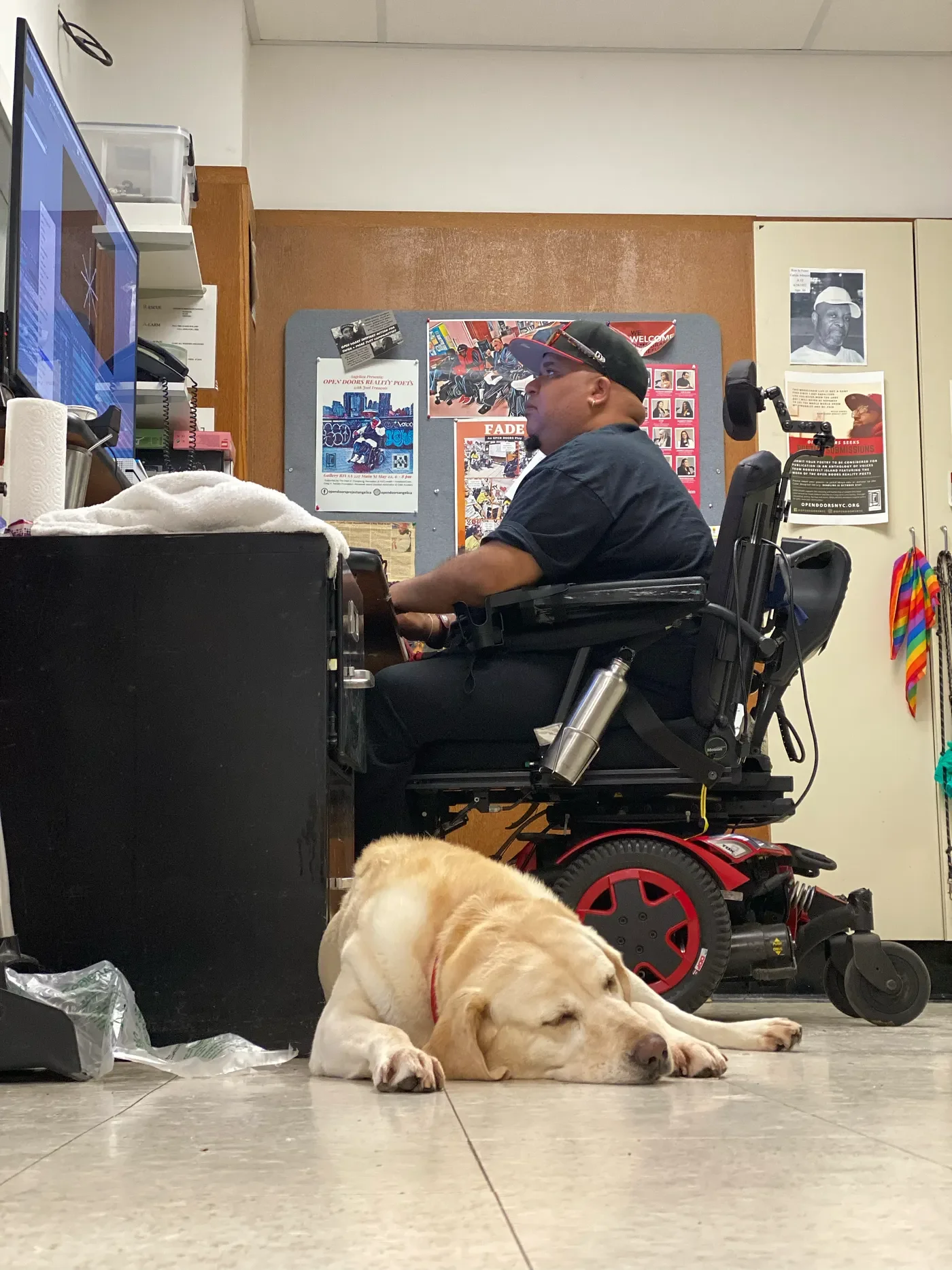
While the sleepy Labrador Momo naps on the floor, Andres Jay Molina, dressed in black and red, is hard at work, focused on video editing while facing a large computer screen with Reality Poets and Fade posters beside him.
Some superheroes are born with special abilities,
Few are turned by tragic events
Others are shaped by possibilities
But we were turned into heroes by our disabilities.
Our desire to overcome our failures,
Ended up turning us into our own saviors
And then we realized we were able,
To be who we wanted to be without being labeled.
After hitting rock bottom and almost dying
We understood it was get rich or die trying
But rich with knowledge instead of rich with money
Rich with desire to help other people
Telling them about the mistakes we made
That led to us being cripple,
We have come so far since our tragedies
Far from being just one of many casualties
We put on a cape and a cowl
Just like the DC hero the night owl
We have shown others that this wheelchair it’s not the end
That instead it’s the beginning of our new lives
Lives that now have a meaning
Lives that are sincerely willing
To keep working with our youth until our last days
Or until our debt to society it’s finally paid.
- Andres “Jay” Molina
The Reality Poets are part of Open Doors, a creative collective of nursing home residents, advocates, and allies. Through art and activism they work to prevent gun violence, strengthen communities, and promote disability justice. They are members of Color Congress, an ecosystem-builder that resources, supports, connects, and champions organizations led by people of color that serve nonfiction filmmakers, leaders, and audiences of color across the United States and US islands.